
Why We Started Tracking AI Bots
In early March 2026, we began logging all AI bot access to mare-interno.com as part of ongoing EdgeShaping operations — tracking which AI systems fetch which pages, and why.
Two months in, we had enough data to do something interesting: cross-reference AI bot fetches against GSC click data, and plot the results on the AHQG Matrix.
What GSC Captures vs. What AI Bots Fetch Are Different Things
GSC records what happens when a human searches and clicks. That signal remains valuable — but it only tells part of the story.
AI bot traffic breaks down into several distinct types. For this analysis, we focused on two:
User-triggered bots: Bots that fetch pages autonomously in response to a human’s question — ChatGPT-User, Claude-User, Perplexity-User. The human didn’t visit the URL; the AI did, on their behalf.
Search/RAG bots: Bots dispatched because a human explicitly provided a URL — Google-NotebookLM, OAI-SearchBot. The human’s intent is more direct here; they chose to feed this content to an AI tool.
Both types share a common characteristic: human intent is the origin. This distinguishes them from crawler bots (GPTBot, ClaudeBot, Meta-ExternalAgent) that operate autonomously for training purposes.
GSC captures human intent through clicks. These two bot categories capture human intent through AI intermediaries. Plotting both on the same axes reveals a distribution GSC alone cannot show.
Plotting Two Months of Data on the AHQG Matrix
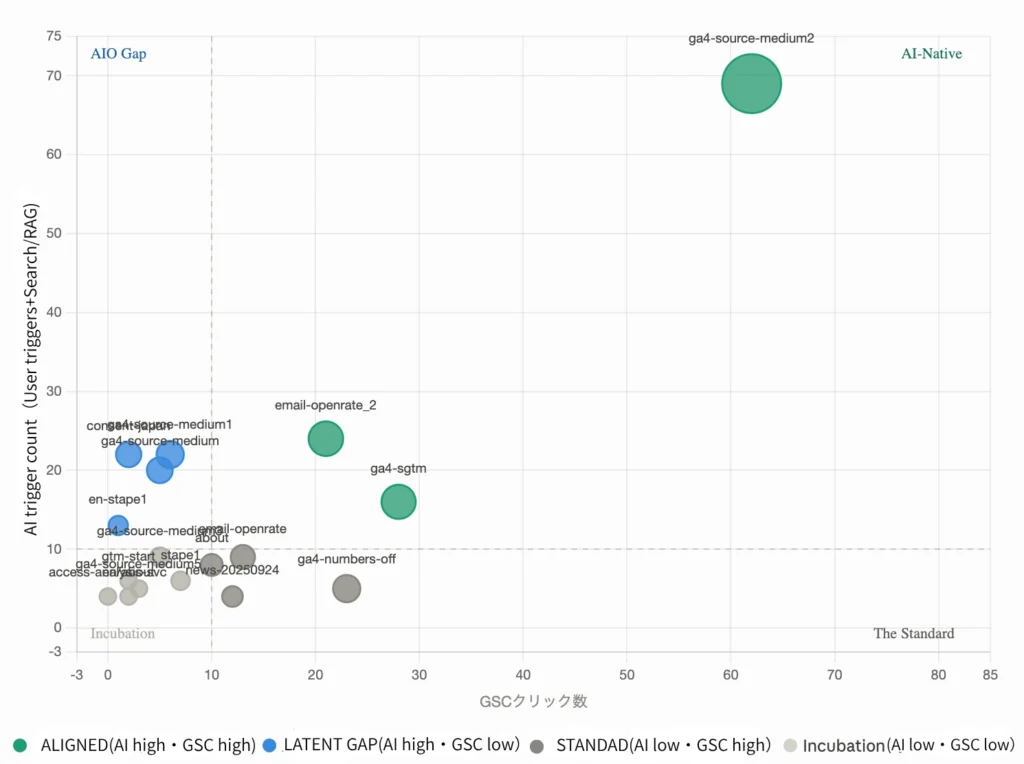
Period: March 5 – April 30, 2026 X-axis: GSC clicks (per page) Y-axis: AI triggers — user-triggered + Search/RAG fetches, content pages only (robots.txt, sitemaps, and auxiliary resources excluded)
Reading the Quadrants
ALIGNED (AI High · GSC High)
Two pages land here.
ga4-source-medium2/ (GSC: 62, AI: 69) covers UTM parameters and GA4 source/medium tracking. It functions as a reference for both humans searching implementation questions and AI systems answering them — a canonical topic that earns both signals naturally.
email-openrate_2/ (GSC: 21, AI: 24) covers email open rate tracking via the Measurement Protocol in GA4. A familiar problem solved with technical depth — it reaches both audiences, but for different reasons than the UTM article.
Same quadrant, different paths to get there.
LATENT GAP (AI High · GSC Low)
The most strategically significant quadrant.
consent-and-measurement-japan/ (AI: 22, GSC: 2), ga4-source-medium1/ (AI: 22, GSC: 6), and en-stape1/ (AI: 13, GSC: 1) all sit here.
AI is already fetching these pages. Human search demand hasn’t materialized yet. The consent article covers CookieYes, Consent Mode v2, and the Japanese CMP landscape — a topic where regulatory pressure is building. Google Signals deprecation is scheduled for June 15, 2026. The AI signal is already there. The GSC signal is not yet.
STANDARD (AI Low · GSC High)
ga4-numbers-off/ (GSC: 23, AI: 5) and news-20250924/ (GSC: 12, AI: 4).
Strong in search, largely ignored by AI. GA4 discrepancy troubleshooting is a high-volume human query — but it’s the kind of content AI systems tend to answer from training data rather than fetch in real time.
INCUBATION (AI Low · GSC Low)
Neither signal is strong yet. Whether these pages move is a question for future observation.
The Matrix Is Not Static
consent-and-measurement-japan/ is currently in LATENT GAP. As Consent Mode v2 implementation becomes a practical requirement for more sites — accelerated by Google Signals deprecation — GSC clicks should follow. If they do, this page moves to ALIGNED.
That movement is what we’re watching for.
Ongoing Observation
We’ll be updating this plot at regular intervals. When meaningful quadrant shifts appear, we’ll publish a follow-up.
AI bot observation powered by EdgeShaping.